

Ever picked up a kitchen tool and had no idea what to call it? I have. More times than I’d like to admit.
That strange gadget in your drawer probably has a name and a specific job in the kitchen, right alongside a few standout decor pieces that make a kitchen feel finished.
Here we cover numerous kitchen utensil names, from the tools you use daily to some rare finds.
You’ll learn what each one does and how to tell similar tools apart.
No confusing jargon here, just plain talk about the tools you already own. By the end, you’ll know exactly which utensil to grab and why.
Kitchen Utensil Categories at a Glance
Before looking at individual utensils, it helps to understand how they’re grouped. Most kitchen utensils fall into categories based on their primary function.
| Category | What It Includes | Main Purpose |
|---|---|---|
| Preparation Utensils | Peelers, graters, colanders, tongs | Preparing ingredients before cooking |
| Cutting Tools | Chef’s knives, paring knives, kitchen shears | Cutting, chopping, slicing, and trimming |
| Measuring Tools | Measuring cups, measuring spoons, kitchen scales | Measuring ingredients accurately |
| Mixing Utensils | Whisks, mixing bowls, spatulas | Mixing, whisking, and combining ingredients |
| Cooking Utensils | Wooden spoons, ladles, slotted spoons, turners | Stirring, flipping, and cooking food |
| Baking Utensils | Rolling pins, pastry brushes, dough scrapers | Preparing dough and baked goods |
| Serving Utensils | Serving spoons, salad servers, cake servers | Serving meals neatly at the table |
Some kitchen utensils are designed for preparing ingredients, while others help with cutting, measuring, mixing, cooking, baking, or serving food.
Knowing these categories makes it simpler to choose the right utensil for every task in the kitchen.
Essential Kitchen Utensils For Beginners
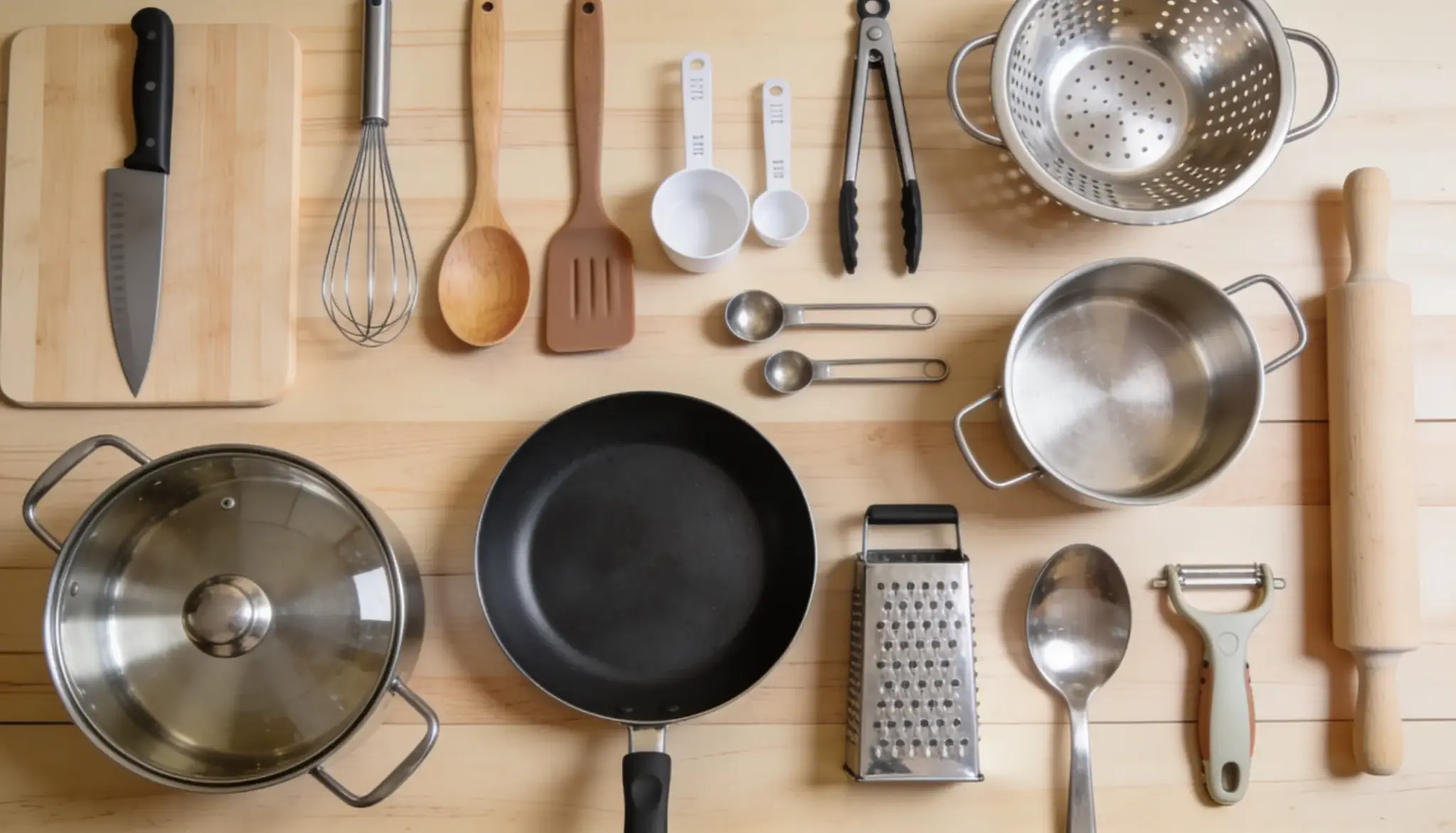
If you’re stocking your first kitchen, start with these essentials, then add more as your cooking skills grow, since a few pantry staples can make weeknight cooking far less stressful.
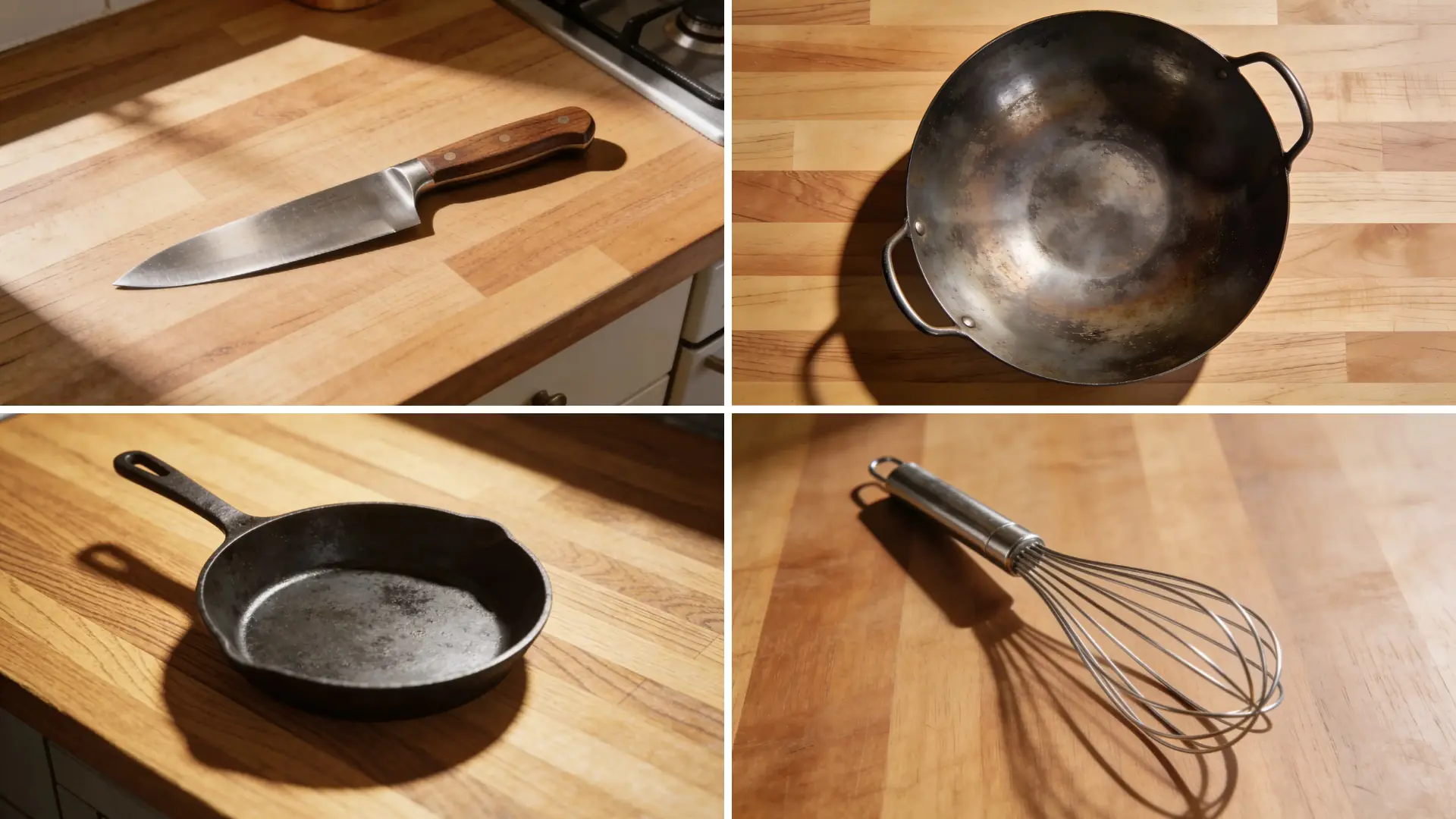
1. Chef’s Knife
A well-balanced chef’s knife typically ranges from 6 to 10 inches, letting you handle everything from delicate herbs to dense root vegetables with one blade.
Keeping it sharp with regular honing also makes cutting safer, since a dull blade is more likely to slip.
2. Cutting Board
Wood and plastic boards are both popular choices, each offering a different balance of durability, knife-friendliness, and ease of cleaning.
Many cooks keep separate boards for meat and produce to avoid cross-contamination, and having a solid carving surface on hand makes slicing roasts and larger cuts far easier.
3. Frying Pan
Nonstick versions make cleanup easier for delicate foods like eggs, while stainless steel or cast iron options handle higher heat for searing.
A comfortable, heat-resistant handle also makes everyday cooking noticeably more pleasant.
4. Saucepan
Sizes typically range from one to four quarts, so having a couple of options covers both small reductions and larger batches.
The tight-fitting lid also helps trap steam, speeding up cooking and keeping flavors concentrated.
5. Wooden Spoon
Its wide, flat surface is also handy for breaking up ground meat or scraping stuck bits from the bottom of a pan.
Because it’s inexpensive and long-lasting, most cooks keep several on hand for different tasks.
6. Whisk
Balloon whisks are best for aerating, while flatter whisk designs work well in shallow pans for sauces and gravies.
A sturdy handle also makes the whisk easier to control during vigorous mixing.
7. Measuring Cups
Dry measuring cups are designed to be leveled off with a flat edge, while liquid measuring cups have a spout and extra headspace for pouring without spills.
Having both types on hand helps ensure recipes turn out as intended
8. Colander
Its wide base and sturdy feet or handles make it easy to set in the sink for hands-free draining. Many colanders also work well for washing berries or leafy greens under running water.
9. Pot
Pots come in a range of sizes, so having a couple of options makes it easier to match the pot to the amount of food you’re cooking.
A tight-fitting lid also helps water come to a boil faster and retains heat efficiently.
10. Wok
Its round bottom concentrates heat at the center while the sides stay cooler.This makes it easy to toss and stir ingredients quickly without spilling them onto the hot stovetop below.
11. Dutch Oven
A heavy pot with a tight-fitting lid, ideal for slow stews, braises, and soups that require long cooking times.
Its thick walls hold heat evenly, helping tougher cuts of meat turn tender over several hours of slow cooking.
12. Stockpot
Its tall, narrow shape reduces evaporation during long simmering, which helps concentrate flavor in stocks and broths.
Sturdy side handles also make it easier to lift and carry when full.
13. Griddle
Some griddles sit directly on the stovetop, while others are standalone electric appliances with adjustable temperature controls.
The flat, wide surface also makes it well-suited for cooking multiple items at once, like several pancakes or eggs side by side.
Prep Tools That Save You Time
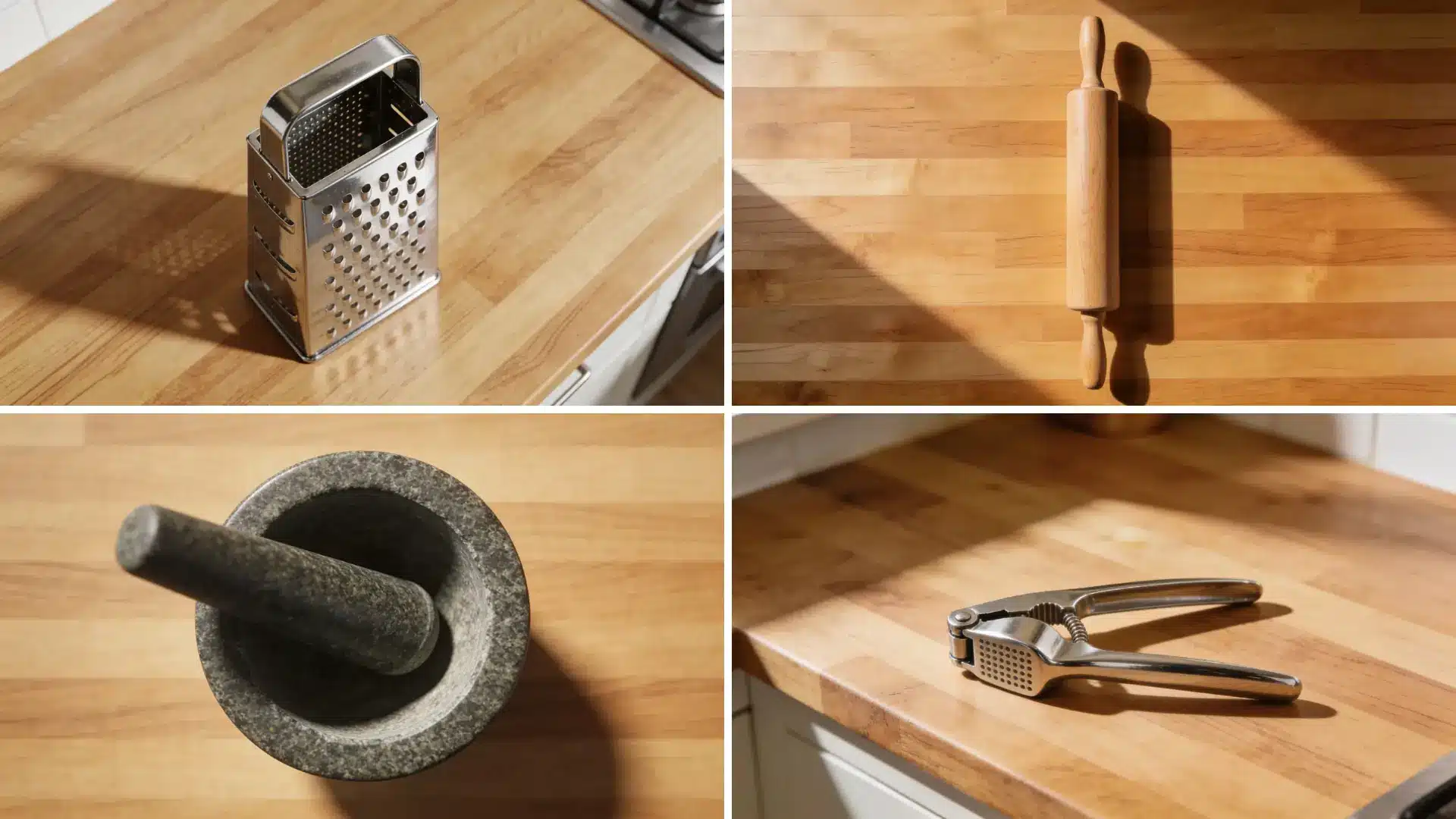
Prep tools get your food ready before it hits the heat.
14. Vegetable Peeler
Swivel-head peelers adjust automatically to the contours of the vegetable, making the job even quicker.
A sharp peeler also reduces the pressure needed, which can help prevent hand fatigue during larger prep jobs.
15. Grater
Box graters usually offer multiple surfaces, from fine zesting holes to larger shredding holes, all in one compact tool.
Some models also include a slicing blade, adding even more versatility to a single gadget.
16. Kitchen Shears
Handle tougher jobs, like cutting poultry or trimming herbs, that a regular knife often struggles to handle cleanly.
And they’re stronger than typical scissors, which can be easily pulled apart for cleaning.
17. Tongs
Many tongs feature a locking mechanism at the handle, which keeps them compact and tidy when stored in a drawer.
Silicone-tipped versions are also gentle enough to use with nonstick cookware without scratching the surface.
18. Garlic Press
Because it crushes the clove whole, it also helps release more of the garlic’s natural oils and aroma compared to slicing.
Many presses come with a matching cleaning tool to make removing leftover pulp quicker.
19. Mortar and Pestle
Crushes spices and herbs by hand, releasing more flavor than pre-ground versions do.
Because the bowl-shaped mortar holds ingredients while the pestle grinds them slowly and evenly.
20. Rolling Pin
French-style rolling pins are tapered and handle-free, giving cooks more direct control over pressure and thickness.
Traditional rolling pins with handles make it easier to apply even pressure across wider sheets of dough
Measuring & Mixing Tools Every Kitchen Needs
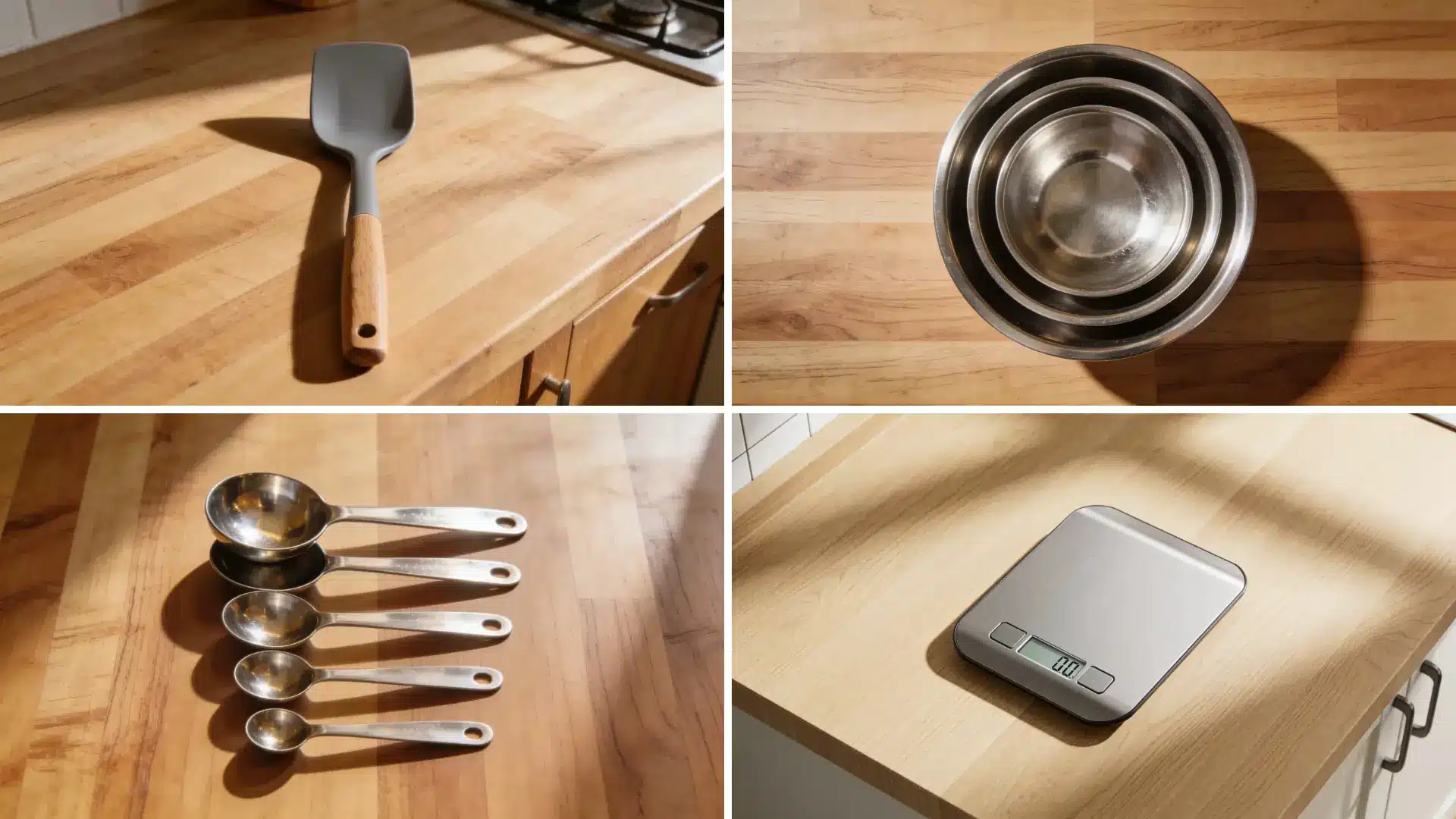
Good measuring tools help recipes turn out more consistently, and mixing tools bring ingredients together into one smooth mix, especially when baking.
21. Measuring Spoons
Handle small amounts, from a pinch to a tablespoon, and are essential for spices, extracts, and other leavening agents too.
22. Kitchen Scale
Weigh ingredients for more precise results than volume measurements allow, which many bakers prefer, since flour can pack differently depending on how it’s scooped into the cup before each use.
23. Mixing Bowls
Stainless steel bowls are lightweight and durable, while glass bowls let you see ingredients clearly and often go straight into the microwave.
Nesting sets also save valuable storage space in smaller kitchens.
24. Silicone Spatula
Because silicone withstands high heat, it’s also safe to use for stirring on the stovetop without melting or warping.
Its flexible head conforms to the curves of bowls and pans, leaving very little batter behind.
Baking Utensils Worth Adding To Your Kitchen
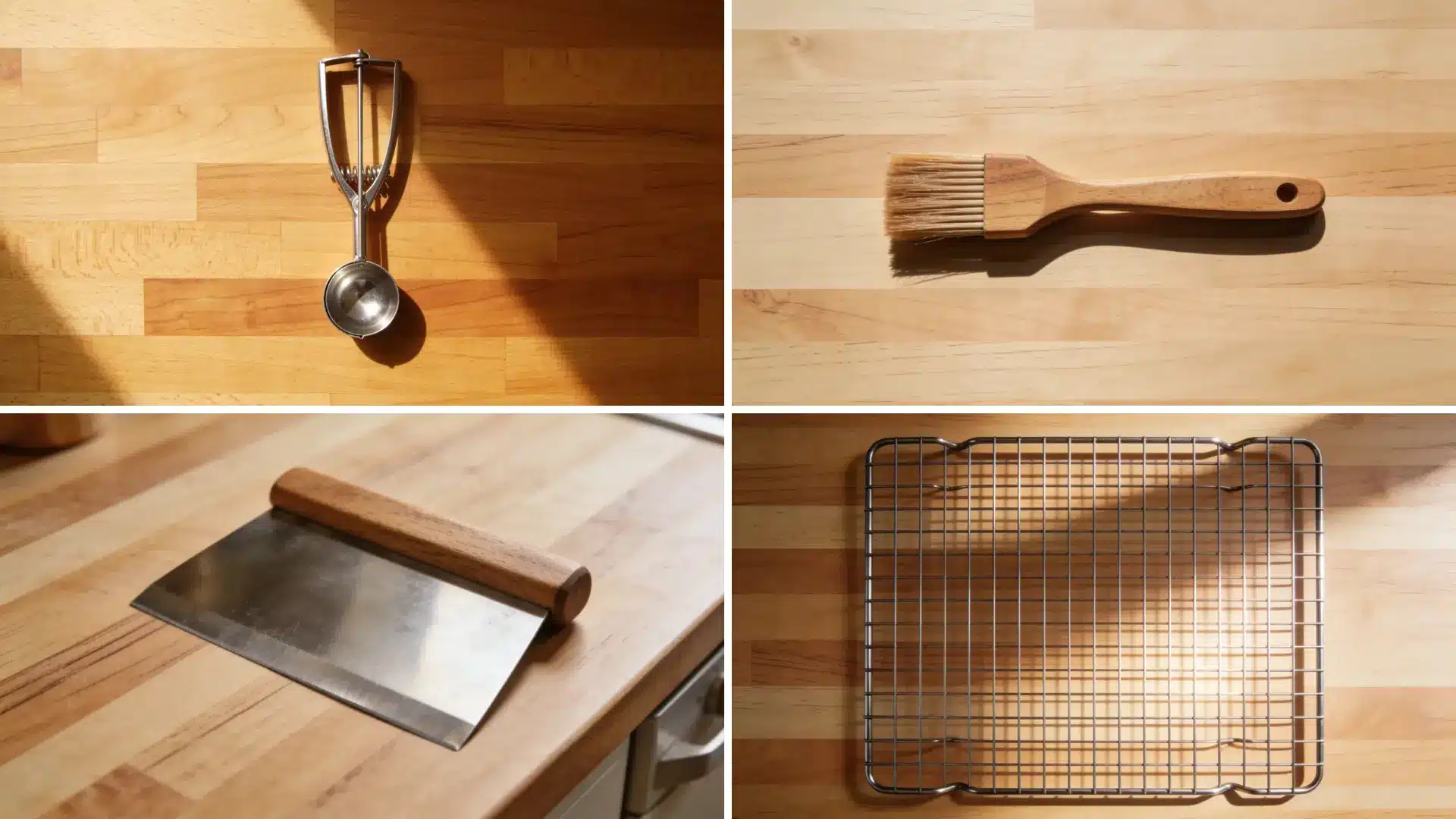
Baking calls for a few extra kitchen essentials beyond your everyday cookware.
25. Pastry Brush
Silicone bristles are easy to clean and resist absorbing odors, while natural bristles tend to hold liquid a bit more evenly.
Either style helps achieve a consistent coating without oversaturating delicate pastry.
26. Dough Scraper
Its rigid edge also makes it useful for dividing dough into equal portions before shaping.
Many bakers rely on it to transfer chopped ingredients from the cutting board straight into a bowl or pan.
27. Cookie Scoop
Different scoop sizes are available, so bakers can choose one that matches the size of cookie they want to make.
Using a scoop also speeds up the process considerably compared to shaping each portion by hand.
28. Cooling Rack
Its raised design allows air to circulate on all sides of the baked good, preventing condensation from making the crust soggy.
It’s also handy for glazing, since drips can fall through the wires instead of pooling underneath.
Cutlery Names Every Cook Should Know
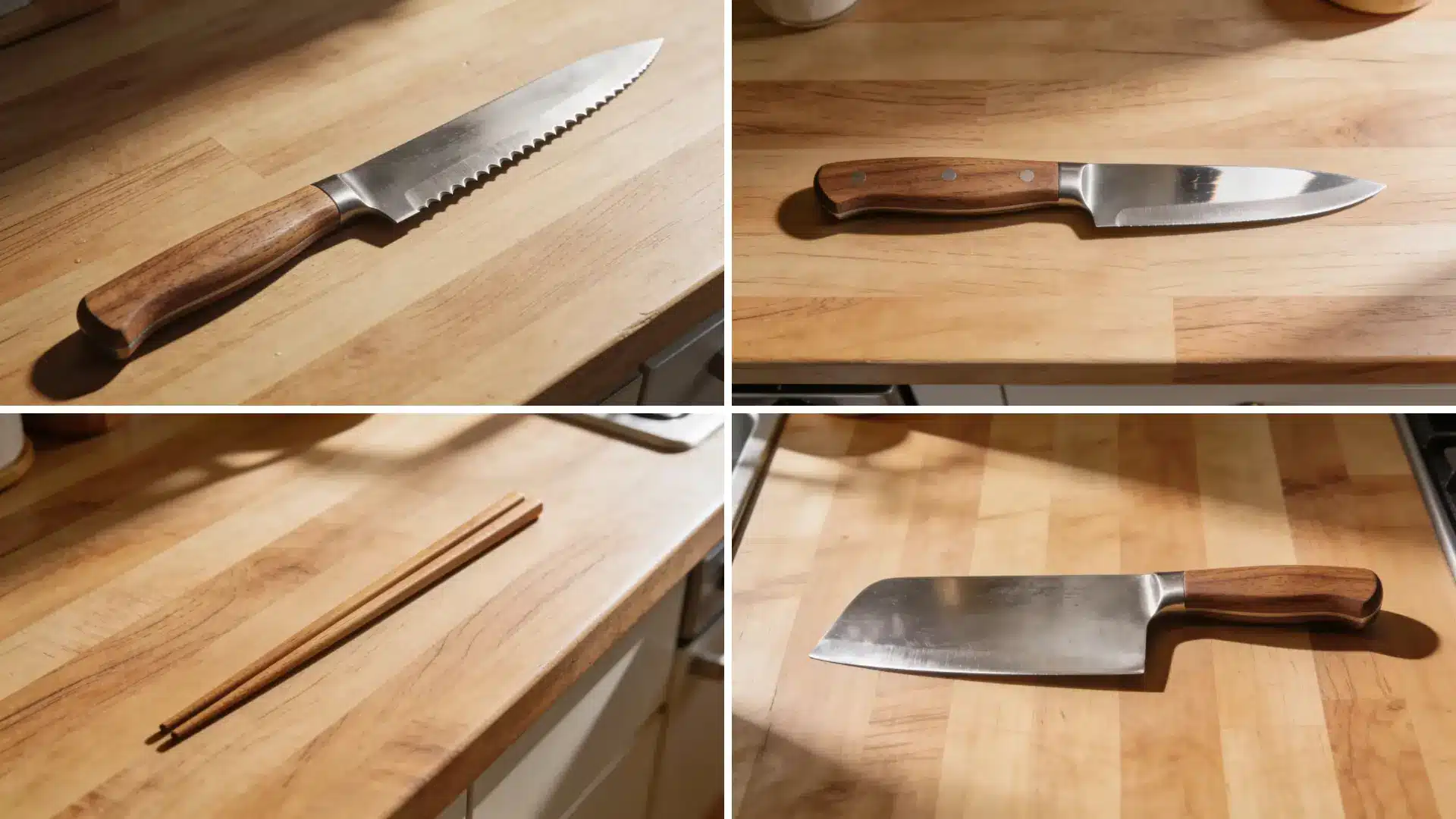
Cutlery covers what you cut with and what you eat with.
29. Paring Knife
Its small size also makes it ideal for tasks like deveining shrimp, hulling strawberries, or removing seeds from small fruits.
Because it’s easy to maneuver, many cooks reach for it for quick jobs that don’t require a full-sized chef’s knife
30. Bread Knife
The serrations grip the crust and pull the blade through cleanly, rather than compressing the soft interior like a straight edge might.
This same sawing motion also makes it useful for slicing delicate cakes without crushing them.
31. Cleaver
Its wide, flat blade also doubles as a handy tool for scooping up chopped ingredients and transferring them to a pan.
Because of its weight, a cleaver requires a firm grip and careful technique to use safely.
32. Chopsticks
Beyond eating, longer cooking chopsticks are also used for stirring, mixing, and even deep-frying, since their length keeps hands away from hot oil.
Reusable chopsticks are common at home, while disposable wooden pairs are often provided at restaurants.
Serving Utensils For The Table
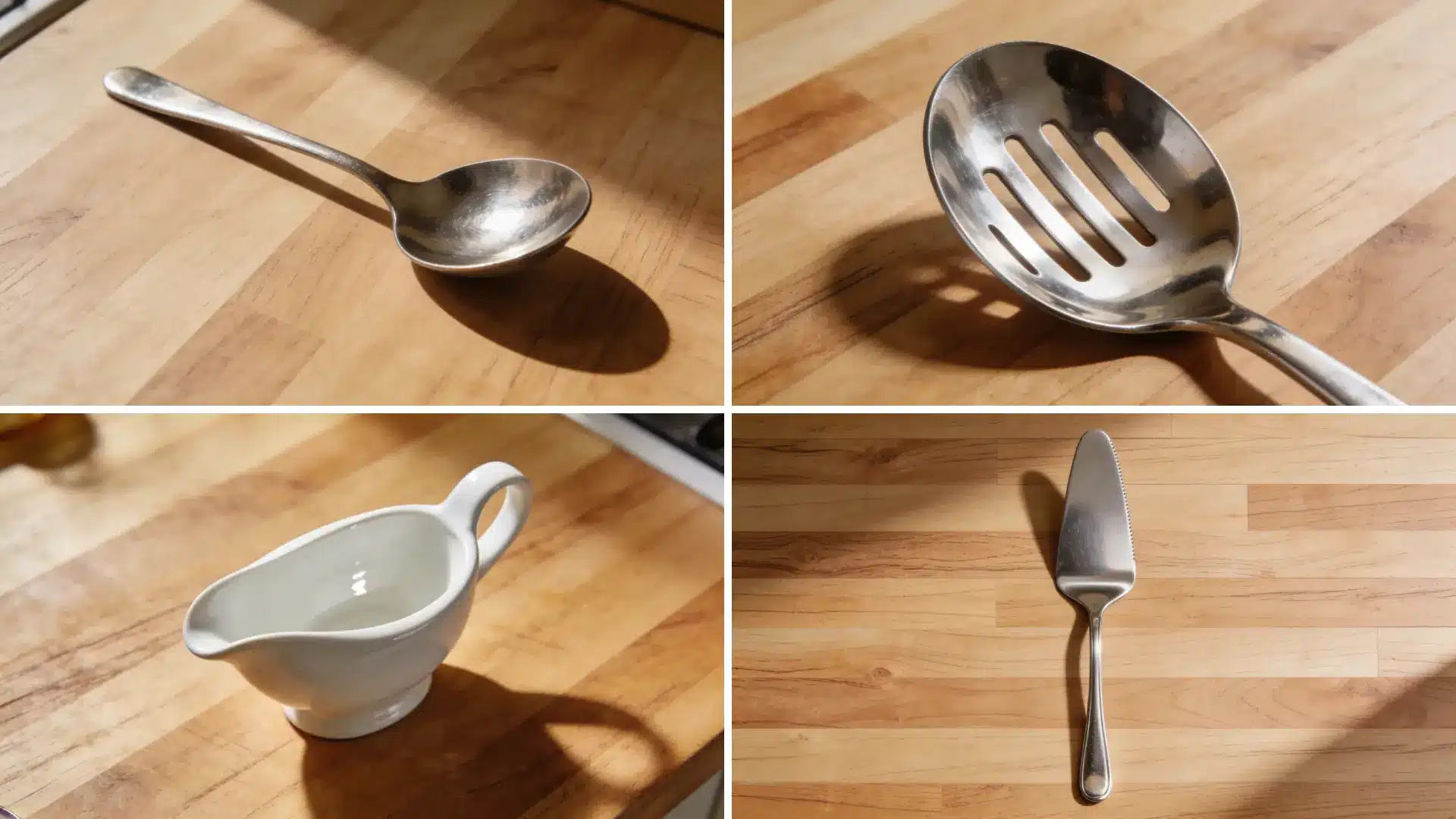
Once the food is cooked, you need the right tool to plate it or pass it around.
33. Ladle
The long handle keeps your hand safely away from the pot, useful when serving something hot off the stove. Many ladles also include a small pour spout that controls the flow of liquid, so soup lands in the bowl, not on the counter.
34. Slotted Spoon
A slotted spoon lets liquid drain away while you lift out solids like vegetables or dumplings, since the small holes do the draining work for you. It’s the easiest way to pull food from a pot without hauling out broth or oil too.
35. Cake Server
A cake server slices and lifts cake in one motion, thanks to its wide, angled blade that keeps each slice intact. The flat edge cuts cleanly through frosting and cake layers, so you get a neat piece without crumbs falling apart on the plate.
36. Gravy Boat
A gravy boat is a small pitcher designed specifically for pouring sauce, with a shape optimized for controlled, drip-free pouring.
The narrow spout and curved lip keep gravy from running down the side, so it lands on the plate instead of the tablecloth.
Lesser-Known Kitchen Tools Worth Knowing
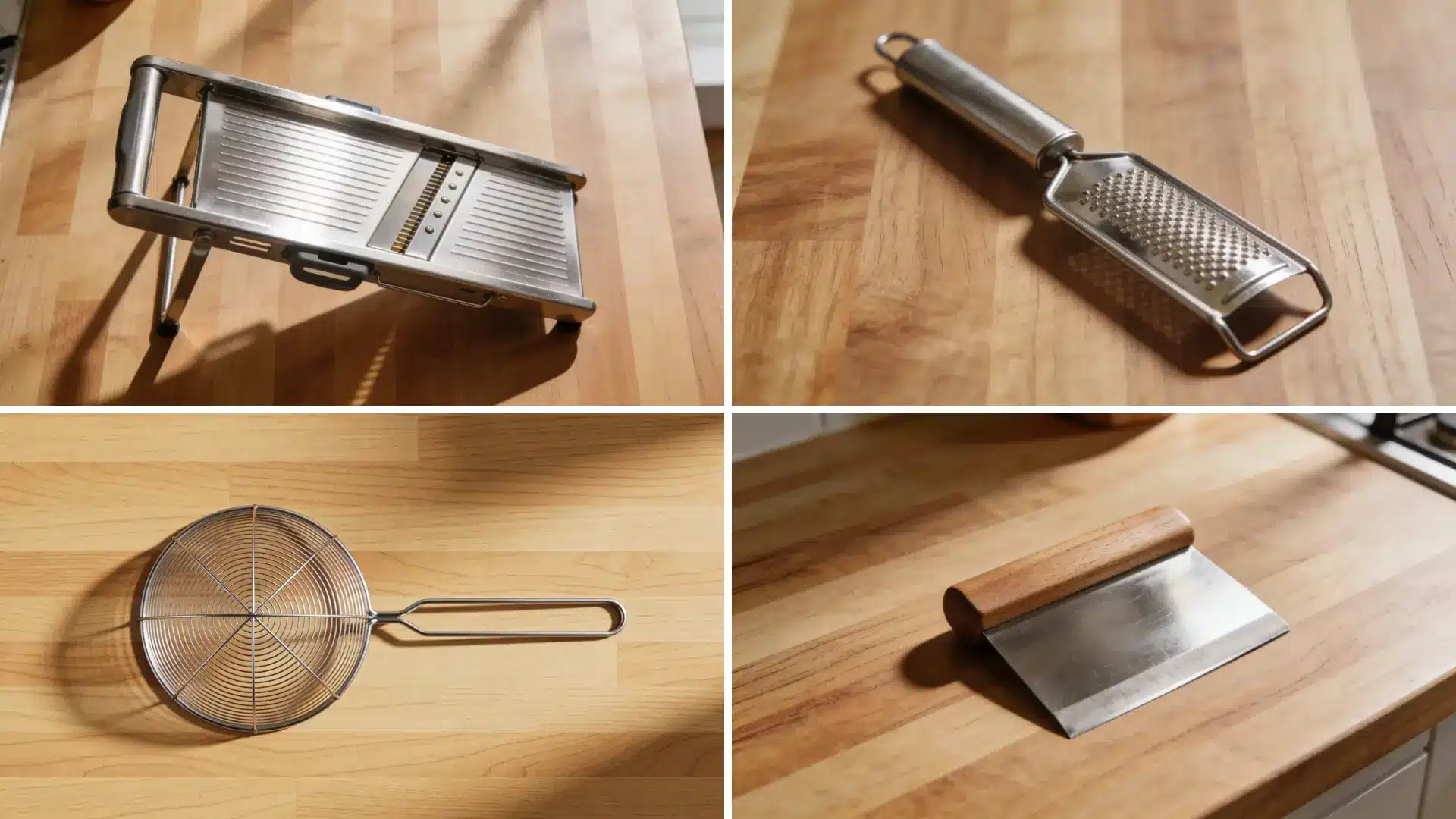
Some kitchen items show up less often, but they’re still worth naming. Many of these are also called kitchen gadgets because each one is designed for a specific job.
37. Mandoline
A mandoline slices vegetables into thin, even pieces far more consistently than a knife can manage by hand. A safety guard is essential, since the blade is extremely sharp and can cause a deep cut in seconds if fingers get too close.
38. Zester
A zester pulls fine zest from lemons and other citrus fruit, and its small holes remove only the outer peel while avoiding the bitter white pith underneath.
It adds bright flavor to baked goods, drinks, and sauces without extra acidity.
39. Melon Baller
A melon baller scoops smooth, round balls from melon or potato, giving fruit salads and plated desserts a clean, polished look. It’s a simple tool, but it turns an ordinary bowl of fruit into something that feels a little more finished.
40. Cherry Pitter
A cherry pitter quickly removes pits from cherries or olives, saving you the tedious job of digging them out by hand one at a time. It pushes the pit straight through, leaving the fruit mostly intact for baking or snacking.
41. Chinois
A chinois is a cone-shaped sieve that strains sauces, soups, and custards until they’re completely smooth.
It removes even the finest solids for a silky texture favored in most professional kitchens, though some home cooks reach for one occasionally too.
42. Spider
A spider is a wire-mesh basket attached to a long handle that skims hot liquid, letting you lift out fried food or blanched vegetables while the liquid stays behind. It drains fast and keeps hands well away from hot oil or boiling water.
43. Lame
A lame is a small blade used to slash the surface of bread dough before baking, letting steam escape as the loaf rises in the oven. Those quick cuts also create the decorative pattern bakers often use to mark a finished loaf.
44. Bench Scraper
A bench scraper lifts and cuts dough off the counter with a single clean motion, making it easier to divide or move without stretching it. It also doubles as a handy cleanup tool, pushing flour and scraps off the counter in seconds.
How To Take Care Of Your Kitchen Utensils
A little care makes your tools last far longer, so a few simple habits now can save you money on replacements down the road.
- Wash wooden spoons and boards by hand, not in the dishwasher. Heat and prolonged moisture can cause wood to crack, warp, or split over time, so a quick hand wash with mild soap helps keep it in shape for years.
- Dry your knives right after washing them. Leaving blades wet invites rust and dulls the edge faster, so a quick towel dry after each use keeps them sharp and rust-free.
- Skip soaking your cast iron skillet in water. Standing water strips the seasoning and can lead to rust, so wipe it out while it’s still warm and season lightly with oil instead.
- Sharpen your knives regularly. A dull blade slips more easily and forces you to press harder, so a regular sharpening schedule keeps cutting safer and far more precise.
Small habits like these protect your tools from everyday wear and tear, keeping your kitchen running smoothly for many years to come.
Conclusion
So, back to that mystery gadget in your drawer.
Chances are, you know exactly what it’s called now.
Now that you know the most common kitchen utensil names, you’ll have an easier time following recipes, shopping for cookware, and choosing the right tool for each task.
Open a drawer and name three tools out loud. Struggled with one? Scroll back up and find it!
Frequently Asked Questions
1. What is The Difference Between Kitchen Tools And Kitchen Utensils?
Kitchen tools cover a wider range, including appliances and larger equipment. Kitchen utensils are usually small, hand-held items used for cooking or prep work.
2. What Are Kitchen Utensils Usually Made Of?
Most utensils are made from stainless steel, silicone, wood, or plastic. Each material suits different tasks. Wood works well for stirring, while silicone protects nonstick pans.
3. How Many Kitchen Utensils Should A Home Kitchen Have?
There’s no fixed number. A well-stocked kitchen usually holds 15 to 30 core tools, depending on how often you cook.
4. Do I Need Different Utensils For Nonstick Cookware?
Yes, in most cases. Metal tools can scratch nonstick surfaces. Silicone, wood, or nylon utensils are a safer choice.
5. What Should I Look For When Buying New Kitchen Utensils?
Focus on the handle grip, the material, and how easy the tool is to clean. A comfortable handle and dishwasher-safe design go a long way.