

How Long Do Seafood Leftovers Actually Last? (AKA: The “Is This Still Alive?” Question)
If you’ve ever stood in front of your fridge holding a sad little container of leftover shrimp like it’s a crime scene exhibit… hi. Same. Seafood leftovers are delicious, but they’re also dramatic they don’t hang around politely for a week like chili. They turn on you faster.
So let’s make this easy: here’s how long cooked seafood lasts, how to store it without accidentally creating a science experiment, and how to tell when it’s time to say goodbye (with love, but firmly).
First: the “don’t make yourself sick” pep talk
Seafood is one of those foods where time and temperature matter more than vibes.
If you know it went into the fridge quickly and your fridge is actually cold? Great. If you have no idea when it was cooked, it sat out on the counter “for a bit,” or it rode around in your car while you ran errands… I’m not saying it’s definitely bad, I’m saying it’s definitely not worth a miserable night.
When in doubt, toss it. Your body is not a compost bin.
The cheat sheet: how long cooked seafood lasts in the fridge
These are refrigerator timelines for cooked seafood (not raw). And yes different seafood has different “I’m fine!” windows.
In the fridge:
- 3-4 days: cooked fish (salmon, cod, tilapia, etc.) and cooked shrimp
- 2-3 days: cooked crab, lobster, scallops, mussels, clams
- 2 days max: cooked oysters (they spoil fast because they’re basically tiny salty chaos nuggets)
Mixed seafood dishes (paella, cioppino, seafood pasta, etc.)
Use the shortest timeline of whatever’s in there. If it includes oysters? Congrats, your whole dish is now living on a 2 day clock.
Restaurant leftovers
Here’s the annoying part: you don’t know how long that seafood sat around before it hit your table. So I treat restaurant seafood like it’s already used up some of its “freshness budget.”
My personal rule: eat it within 24 hours or freeze it that night. (Yes, even if it was expensive. Food poisoning does not care about your receipt.)
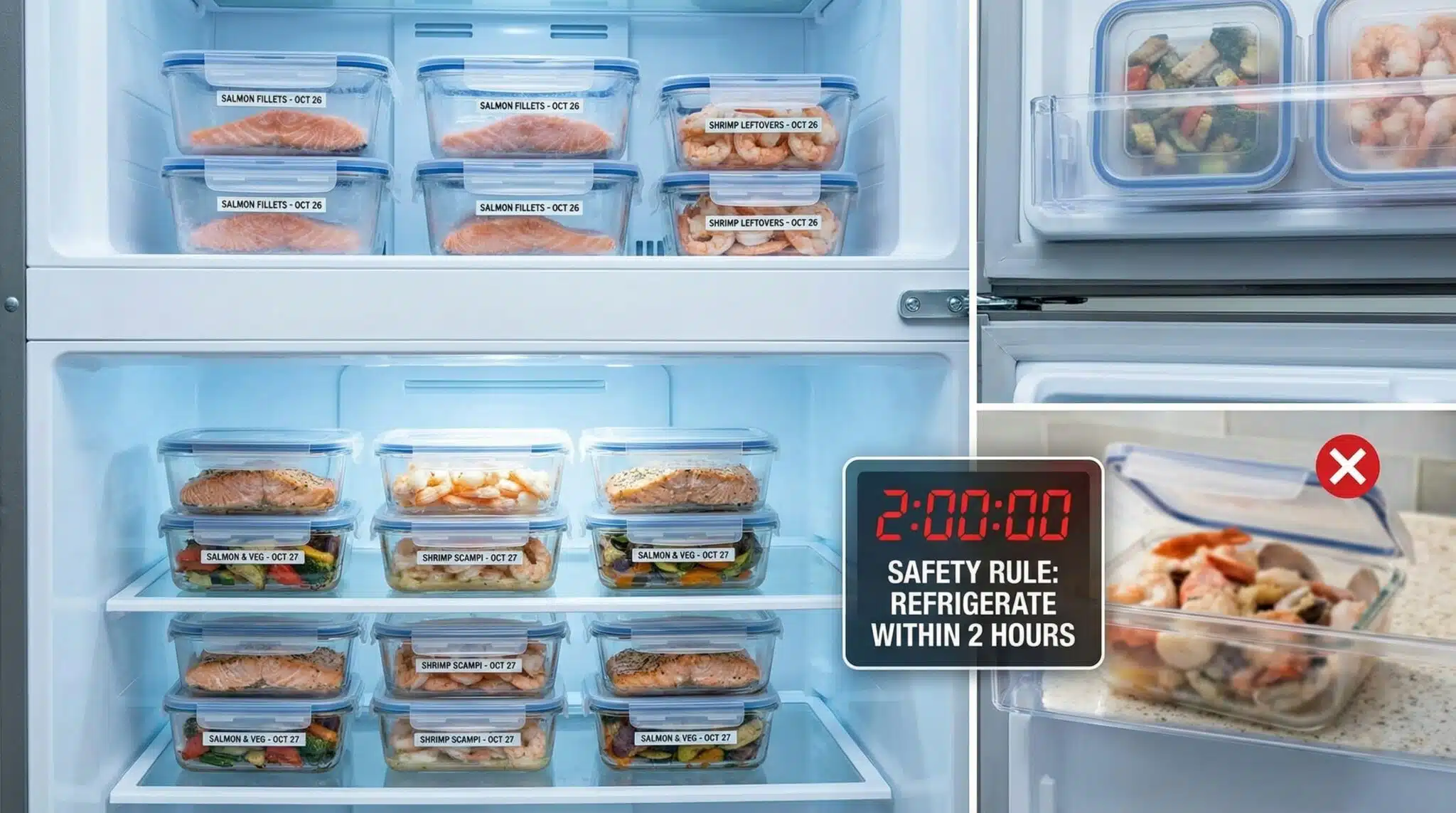
The two hour rule (the one I wish I could ignore, but can’t)
Once seafood is cooked, the timer starts. You’ve got:
- 2 hours to get it into the fridge
- 1 hour if it’s super hot out (above 90°F hello summer cookouts and “why is my kitchen a sauna” days)
And please don’t do the “I’ll just leave it out until I feel like dealing with it” thing. I have done it. I regretted it. Learn from my crimes.
Make it cool faster: put leftovers in shallow containers (think: not a deep mound of shrimp where the center stays warm forever). If you’re feeling fancy, leave it uncovered for 20-30 minutes to let steam escape, then seal it up.
If it missed the 2 hour window? I know. It’s heartbreaking. Throw it out. Seafood does not negotiate.
Your fridge might be lying to you
This drives me bonkers, but it’s real: a lot of fridges run warmer than you think.
- Your fridge should be 40°F or colder
- The coldest, steadiest spot is usually the back of the lowest shelf (not the door never the door)
If you want to be mildly horrified in a productive way, stick a cheap fridge thermometer in there and check it the next day.
Freezing seafood leftovers: safe forever, tasty… not forever
At 0°F, frozen seafood stays safe indefinitely but quality is a whole other story. Freezer time can turn beautiful salmon into “why is this simultaneously dry and mushy” territory.
Here’s what tends to freeze best (quality-wise):
- Crab & lobster: surprisingly solid for 10-12 months
- Fish & shrimp: best within 2-3 months (up to 6 months if vacuum sealed)
- Fatty fish (like salmon) usually goes downhill faster than lean fish (like cod)
- Scallops, mussels, clams: ehh… try to use within 1-2 months
- Cooked oysters: I’m sorry, but don’t bother freezing them. Texture gets weird and grainy, like they’re mad at you.
How to freeze it without freezer burn sadness
Air is the enemy. Air is how you end up with gray, dry “seafood jerky” patches.
My realistic ranking:
- Vacuum seal (best, but not required to be a functioning adult)
- Wrap tight + wrap again: plastic wrap pressed right against the seafood, then foil
- Freezer bag with the air squeezed out: you can do the water displacement trick (lower the bag into water to push the air out, then seal)
Also: freeze in meal sized portions. Do not freeze one giant brick of shrimp unless you enjoy thawing a whole brick of shrimp.
When to freeze vs. refrigerate
- If you’re going to eat it in the next day or two: fridge is fine.
- If you’re staring down Day 3 and thinking “maybe?”: freeze it now.
- If you’re not sure you’ll eat it: freeze it the day you cook it. Seafood freezes best when it’s still at its peak not when it’s on its last safe day limping toward the finish line.
Thawing: do it safely, or don’t do it at all
You’ve got three safe options:
- In the fridge (best): takes 8-24 hours depending on thickness
After it’s thawed, you’ve got about 1-2 days to eat it. - Cold water (fast): sealed bag, submerged in cold water, change water every 30 minutes
Cook it immediately after. - Microwave (last resort): uneven and it can start cooking edges
Cook it immediately after.
Never thaw seafood on the counter. The outside hits the bacteria “party zone” while the inside is still frozen, and nobody wants that.
Can you refreeze thawed seafood?
Only if it thawed in the fridge and stayed cold the whole time. Even then, the texture usually takes a hit.
If you thawed it in cold water or the microwave: cook it first, then you can freeze the cooked version.
How to tell if seafood is bad (without playing chicken with your stomach)
I know we all want a cute, simple answer like “if it smells bad, toss it.” Unfortunately, seafood can be unsafe before it smells like doom.
So do it in this order:
- Count the days (seriously, this is #1)
- Then check for obvious signs
Toss it if:
- It’s past the recommended time
- You don’t know when it was cooked
- It sat out too long
- The fridge lost power / it was left in a warm car / anything “temperature drama” happened
Red flags:
- Sour, ammonia, or “why does this smell like a chemistry lab” odor
- Slimy/sticky surface
- Gray discoloration on white fish, browning on pink fish
- Mushy texture that feels… wrong
Reheating seafood without turning it into rubber
Leftover seafood is already cooked you’re just warming it. Use moist flavorful reheating tips.
- Oven (my favorite): 275-325°F, covered with foil, 10-20 minutes
Add a splash of water or broth before covering to keep it moist. - Stovetop: medium low in a covered pan, 4-6 minutes (great for saucy dishes)
- Air fryer: 350°F, 3-5 minutes (best for breaded/fried things)
- Microwave: only if you must use 50% power in short bursts and stop the second it’s warm
Aim for 145°F if you’re checking with a thermometer.
Also: for boil bag reheating steps reheat it once. Don’t reheat, put it back, reheat again. That’s how leftovers go from “dinner” to “regret.”
The bottom line (the version you’ll actually remember)
- Seafood leftovers move fast: fish/shrimp 3-4 days, most shellfish 2-3, oysters 2
- Get it into the fridge within 2 hours
- If you won’t finish it in time, freeze it sooner, not later
- Thaw in the fridge, not on the counter
- When you’re unsure, toss it because saving $8 worth of shrimp is not worth losing a weekend to food poisoning
Now go check that container in your fridge. And if it’s mystery seafood from “sometime this week”… I support you in letting it go.