

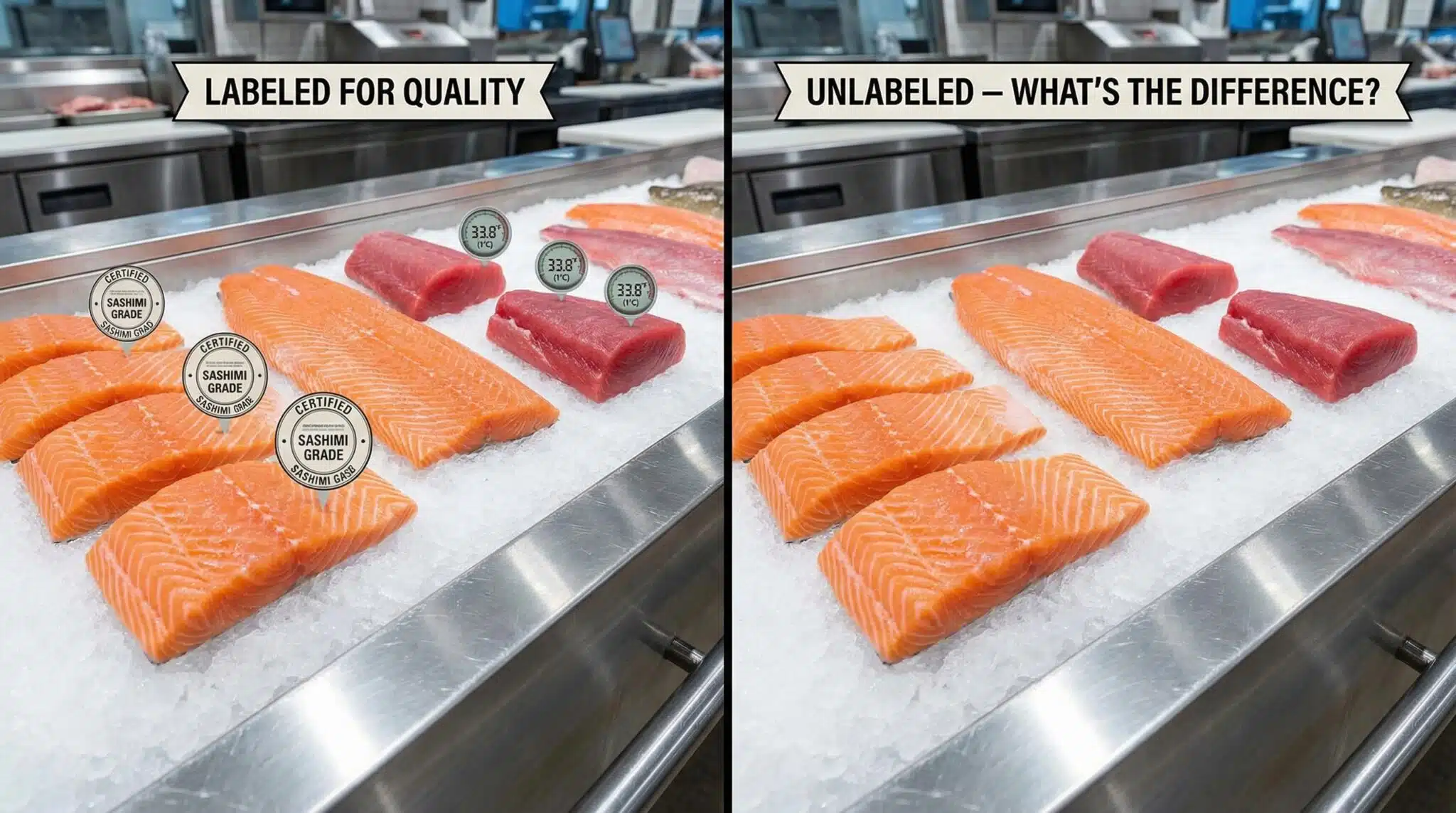
The “Sashimi Grade” Lie (and What Actually Makes Raw Fish Safe)
If you’ve ever stood at the fish counter staring at a little sticker that says SASHIMI GRADE like it’s a legal document… same. I used to think that label meant the fish had been blessed by a sushi priest and escorted into the store on a velvet pillow.
It does not.
“Sushi grade” and “sashimi grade” are basically marketing vibes. There’s no official government definition, no certification, no sashimi grade police. One shop might be doing everything right (fast freezing, careful handling, solid records) and another shop might slap the same words on a random salmon fillet that’s been aging in the case since Tuesday. Same sticker. Very different reality.
So if you want to eat raw fish without playing Parasite Roulette, here’s what actually matters.
First: that label isn’t regulated (at all)
Let’s get this out of the way: the FDA doesn’t regulate “sushi grade” or “sashimi grade” as a term. A seller can use it however they want. It’s not a guarantee of parasite free fish, perfect handling, or even good flavor.
Also tiny rant sometimes you’ll see people act like sashimi grade is “higher” than sushi grade because sashimi is served plain. That’s just… poetry. Not policy.
So what should you trust instead? Two things:
- How the fish was frozen (and when)
- How the fish has been handled and stored since then
And yes, you’re allowed to ask about both. If they act offended, that’s information too.
The real MVP: freezing (done the right way)
If you only remember one thing from this post, make it this:
Freezing—at specific temps for specific times—is the proven way to kill parasites in fish meant to be eaten raw.
The FDA’s parasite kill options (simplified) look like this:
- -4°F (-20°C) for 7 days
- -31°F (-35°C) for 15 hours (commercial “flash freeze” territory)
- -31°F until solid, then -4°F for 24 hours
This is why a lot of truly “raw ready” fish is actually previously frozen on purpose. Sometimes the best fish for sashimi is the fish that was frozen quickly and properly right after catch not the “fresh never frozen” filet that’s been slowly… existing… under fluorescent grocery store lighting.
One big catch (because there’s always a catch):
Freezing helps with parasites, but it does not reliably kill bacteria like Listeria, Salmonella, or Vibrio. That’s why sourcing and cold handling still matter a ton.
Your home freezer is not a magic parasite zapper
I love my freezer. She’s loyal. She holds my emergency garlic bread and the mystery bag of corn I’ve moved to three different houses.
But she is not a commercial blast freezer.
Most home freezers hover around 0°F, and they’re not designed for the parasite kill protocols above (especially the deep freeze ones). Plus slow freezing can wreck texture, which is how you end up with sashimi that feels like wet cotton. No thank you.
So instead of trying to DIY your way into “sushi grade,” your best bet is to buy fish that was already handled and frozen correctly before it got to you.
Quick “is this fish even good?” check (use your senses, not the sticker)
Even if fish is technically safe, it can still taste sad. Here’s my quick, nosy person checklist at the counter:
- Smell: It should smell clean, mild, maybe a little briny like the ocean, not like a dock. If it smells sour, ammonia-y, or aggressively fishy, walk away. Casually. Like you didn’t just get personally insulted by a salmon.
- Texture: Press it gently. It should feel firm and springy. If it stays dented, feels mushy, slimy, or leaks a bunch of liquid… nope.
- Look: You want glossy and fresh looking, not dull, grayish, or drying out on the edges.
Quick tuna side note (because tuna likes to be confusing):
Some tuna is treated with carbon monoxide to keep it looking bright red longer. It’s legal in the U.S., but not everywhere. If a piece of tuna looks weirdly uniformly red, it might be “color enhanced.” You usually won’t know unless you ask (labels can be vague), so if you care, ask.
The fish that follow different rules (because of course they do)
A few categories deserve their own little corner of drama:
Tuna often gets a pass
Certain tuna species (like yellowfin, bigeye, bluefin) are less likely to carry parasites, so they’re commonly sold “never frozen” for raw use. This is one of the rare times “never frozen” can actually make sense.
Salmon depends on where it came from
- Wild salmon: higher parasite risk → typically should be properly frozen for raw eating.
- Farmed Atlantic salmon (from controlled systems): lower risk in many cases. Still, I personally want a seller who can clearly tell me what it is and how it was handled.
Freshwater fish: please don’t
Trout, tilapia, catfish freshwater fish generally have risks that the standard “marine fish freezing rules” don’t solve. If you’re thinking about raw freshwater fish, I’m going to gently take the plate out of your hands and slide you a cooked option instead.
What I ask at the fish counter (aka: the polite interrogation)
You don’t need to grill them like you’re auditioning for a detective show, but you do want real answers not word clouds.
Here are the questions that separate a knowledgeable fishmonger from someone who just likes stickers:
- “Was this fish frozen for raw consumption? At what temp and for how long?” You want actual numbers or a clear process not “Oh yeah it was frozen properly.”
- “How long after catch was it frozen?” Faster is better. “We don’t know” is… not my favorite answer.
- “Was it frozen at sea or on land?” Either can be fine, but they should be able to tell you.
- “Is this wild or farmed?” Especially important for salmon.
- “Has it been thawed in the case?” Repeated freeze/thaw cycles can mess with quality (and it’s just nice to know what you’re buying).
And yes: specialty fish markets and Japanese/Korean groceries often do this better than a random supermarket counter where the fish guy also has to stock rotisserie chickens. No shade. Just reality.
Once you get it home: handle it like it’s on a timer (because it is)
Raw fish is not the moment for “eh, it’ll probably be fine.” Here’s a safe fridge storage window:
- Fridge it immediately (40°F or colder). Bottom shelf, toward the back, in a covered container. Not next to your pre-cut fruit. Please.
- If you’re not eating it soon, freeze it right away (tight wrap or vacuum seal). And don’t do the thaw/refreeze tango.
- Thaw in the fridge, still wrapped, and plan to eat it the day it’s fully thawed.
When to toss it
If it smells sour/ammonia like, feels slimy or mushy, or looks off in a way your gut is screaming about throw it out. I know wasting food hurts. Food poisoning hurts more.
Who should skip raw fish (even if it’s “the good stuff”)
I’m not here to ruin your sushi night, but some people truly shouldn’t gamble with raw seafood:
- Pregnant people (especially because Listeria is a serious risk and freezing doesn’t fix that)
- Immunocompromised folks (chemo, transplant meds, HIV/AIDS, immunosuppressants, etc.)
- Young kids and older adults (foodborne illness hits harder)
- Anyone with chronic conditions where your doctor has told you to be cautious with raw foods
If that’s you, you still get to have delicious things. Go for cooked sushi toppings (shrimp, eel, etc.) or hot smoked salmon (not cold smoked, which isn’t fully cooked) if you want sushi and sashimi explained.
My bottom line: stop trusting the sticker, start trusting the process
“Sashimi grade” is a comforting little label… but comfort isn’t the same thing as safety.
If you want to eat raw fish with confidence, focus on:
- verified freezing practices
- clean handling + cold chain
- a seller who can answer basic questions without panicking
- and your own senses (your nose is smarter than a marketing tag)
Because you deserve sushi night that ends with “that was amazing,” not “why am I googling symptoms at 2 a.m.”