



Sports monitoring and analysis have evolved rapidly, especially as artificial intelligence has changed the way people understand every match and decision. Today, football clubs, analysts, and fans rely increasingly on real-world data and statistics rather than intuition alone. Statistics can help you evaluate gameplay and decisions more effectively, so studying relevant data and analysis before forming conclusions has become an important part of modern match analysis.
How Artificial Intelligence Changed Football Analysis
Artificial intelligence processes data from large numbers of matches. Cameras record player movements, passes, distances covered, and other actions throughout a game. Algorithms then analyze these data points and turn them into insights that would be almost impossible to identify with the naked eye. Based on this information, teams can develop a clearer understanding of their performances using measurable evidence rather than estimates based only on qualitative observation.
Many modern applications rely on this data and present it to users in an accessible format. You can (Arabic: MelBet تحميل) to view real-time statistics alongside each match directly from your phone screen. The MelBet platform provides detailed information about shots, possession, and expected goals around sporting events. This type of digital analysis helps users follow matches with greater depth and clarity.
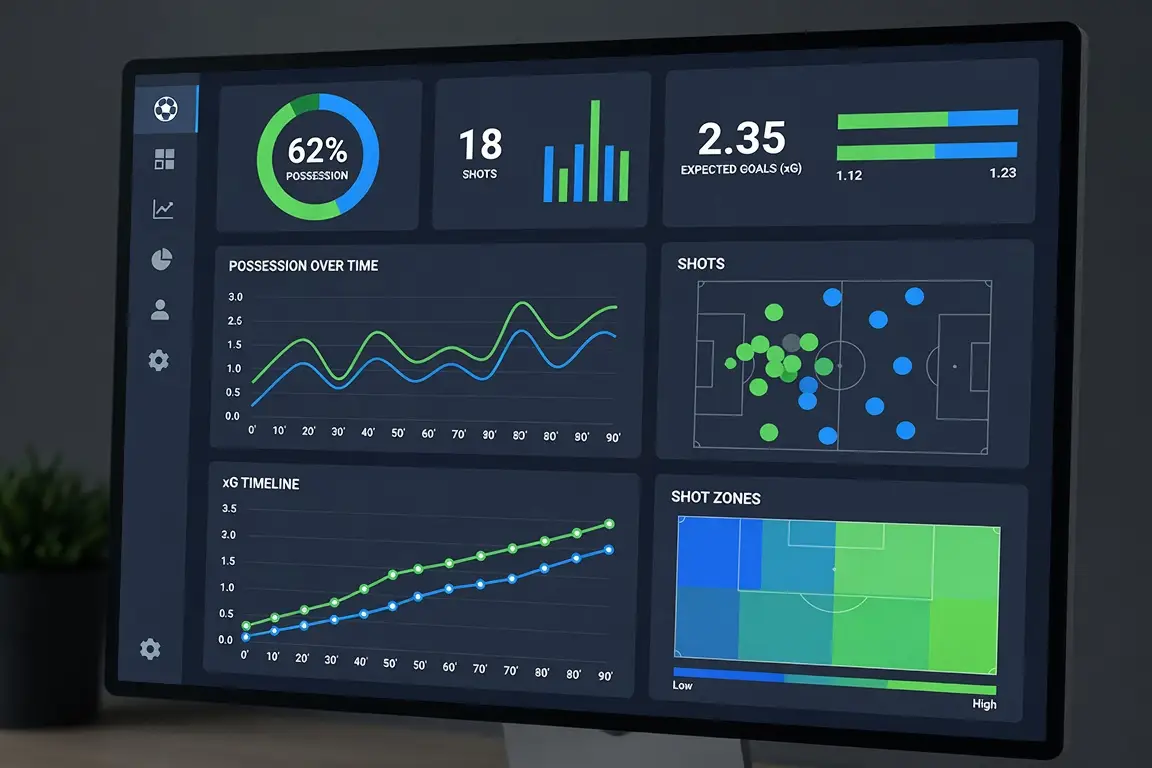
The Main Performance Indicators Measured by AI
Not every number recorded during a match is equally useful for analysis. Some metrics reveal the quality of a team’s performance, while others help explain specific tactical or physical aspects of the game. Analysts therefore focus on selected data points that provide a broader picture of what is happening on the field.
- Expected goals (xG), which measure the quality of chances rather than simply the final score.
- Shots from inside the penalty area, which reveal the genuine threat of an attack.
- Effective possession, which shows how much meaningful control each team has.
- Heat maps, which illustrate where players move during the match.
- Distance covered, which reflects a team’s physical workload.
The influence of this data has also extended clearly into sports betting. Users who study statistics carefully can base decisions on more information rather than pure guesswork, while (Arabic: المصدر) provides further details about the application and how it works. Platforms such as MelBet offer different markets in which users may consider performance statistics and match information before events. However, no statistic can guarantee a result, because football remains unpredictable until the final whistle.
The tools used for sports analysis only a few years ago were considerably simpler. Today, advanced camera systems and sensors can track thousands of data points, measuring details ranging from player speed and movement angles to team formations and positioning. This information can then be converted into reports for coaches and analysts.
These developments have significantly improved the speed and depth of performance analysis. Coaches can access information that helps them understand tactical situations in greater detail, while analysts have an entirely new set of tools available to them.
Such data is particularly useful when a coach needs to make a tactical decision during a match. Instead of relying exclusively on instinct, the coaching staff can use detailed information to assess what is happening on the pitch. Predictive tools can also help teams model possible scenarios and prepare responses rather than simply reacting after events unfold.
Indicator | What It Reveals About the Match |
Expected goals (xG) | Quality of chances beyond the final score |
Shots inside the box | How often the attack creates genuinely dangerous situations |
Effective possession | How much meaningful control each team has |
Heat maps | Areas where players operate during the match |
Predictive models | Potential scenarios before they occur |
It is important to interpret sporting statistics in relation to one another. A team may dominate possession but still struggle to win if it fails to create dangerous attacking situations. Analysts therefore need to combine several metrics to develop a complete picture.
Leading clubs gain a competitive advantage from their ability to measure and document sporting events accurately. High-quality data can provide insights before a match and continue supporting decisions until the final whistle.
Unlike human observers, automated data collection can continue without fatigue. These systems record errors, successful passes, positional changes, and other actions while comparing them with historical events. Technology has therefore expanded sports analysis far beyond what one coach could achieve alone.
The strongest approach to modern sports analysis combines human and machine intelligence. Technology gathers and organizes the information, while coaches and analysts interpret the data in context and decide how best to respond.

Sports Betting Between Data and Responsible Play
People who view gambling as a potential source of income should instead approach it as a form of entertainment. Reliable betting data may help users understand sporting events more clearly, but it cannot reveal the final outcome in advance.
Many gambling platforms provide tools that allow users to set financial and time limits. Gambling services should also be restricted to people aged 18 or older, with support options available for anyone who feels they are losing control.
Responsible users take time to compare betting options, consider probabilities, and understand the tools provided by a platform. Reviewing previous results, player absences, and physical condition can provide useful context, but it does not remove the unpredictable nature of sport. The objective should always remain entertainment rather than guaranteed profit.
Before participating, it is useful to establish a fixed budget and stick to it. Setting limits on both time and money can reduce impulsive decisions caused by excitement. Users should also remember that gambling products are designed with a mathematical advantage for the operator.
For this reason, self-discipline and personal limits are essential parts of safer gambling. Entertainment should not depend on winning or losing. Much of the enjoyment can come from following and analyzing the match itself rather than attaching financial pressure to every outcome. Choosing licensed and regulated platforms also provides stronger standards of accountability and consumer protection.
How Ordinary Fans Benefit From These Technologies
Ordinary sports fans now face far fewer barriers when accessing performance statistics that were once available mainly to professional analysts. Detailed metrics can be viewed directly on smartphones, making the match-watching experience more interactive and informative. Fans can increasingly form opinions about a player’s performance using analytical evidence rather than intuition alone.
Modern applications allow supporters to track almost every aspect of their favorite teams. Users can check team news, injuries, historical results, and other relevant information before a match begins. Several simple habits can make digital analysis more useful:
- Compare both teams’ performances across their last five matches before drawing conclusions.
- Review injuries and absences before forming a final opinion.
- Follow expected goals alongside the score to understand the underlying performance.
- Use more than one reliable source to avoid outdated information.
- Keep your own notes to measure how accurate your analysis becomes over time.
This approach turns sports analysis into a practical learning process. Over time, fans can better understand how tactical decisions influence the wider development of a match. Watching sport then becomes not only immediate entertainment but also an opportunity to gain new insights and perspectives.
Although football is one of the clearest examples, the same trend is visible across other sports. Data analysis has become increasingly common in basketball, tennis, and many other competitions. Artificial intelligence is now becoming a mainstream part of the sports industry, and virtually every discipline can benefit from better information.
For analysts and fans, this creates an especially interesting period. The data being generated is likely to become more precise and accessible, while analytical tools should become easier to use. In the coming years, smarter and more affordable technology may make interactive match analysis a standard part of the viewing experience across many devices.
The Bottom Line on Intelligent Match Analysis
Artificial intelligence has demonstrated that sporting data can reveal patterns that are difficult for the human eye to detect alone. Expected goals, shot locations, heat maps, and many other indicators can help explain why a team performs well or struggles during a match.
For Arab sports fans, these analytical tools can now be applied to almost every major competition. Ultimately, the most important principles remain the same: use reliable information, interpret statistics carefully, and approach betting or gaming responsibly.