


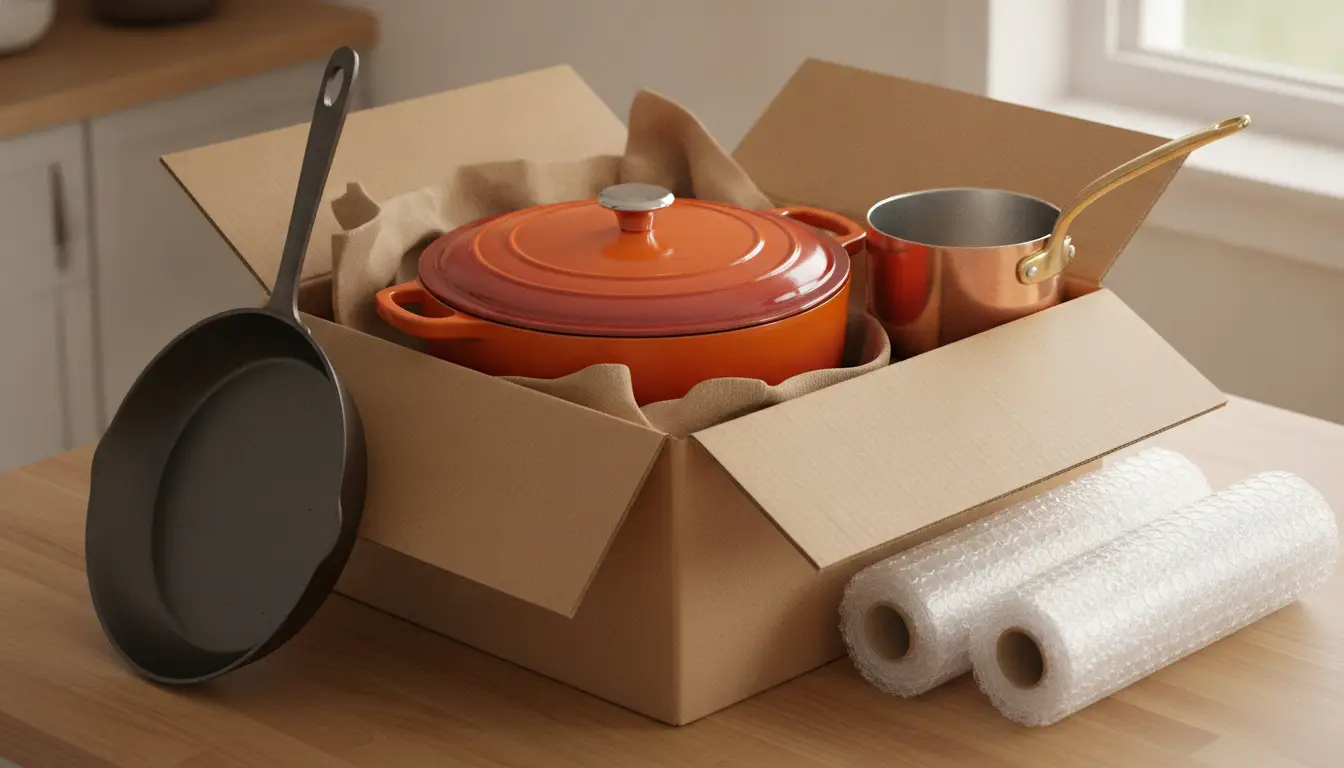
Cookware gets packed like it’s indestructible, which makes sense right up until the box gets opened in a new kitchen. It’s metal. It survives 450 degrees. The last thing that needs bubble wrap.
Then a Dutch oven that cost three hundred dollars comes out with a chipped rim, a carbon steel pan arrives orange, and a glass lid turns out to have been in three pieces since somewhere around Oklahoma. Long-distance moves are harder on a kitchen than local ones, and the reasons have less to do with handling than with time and temperature.
Know What Actually Fails
Different materials break in different ways, and packing for the wrong failure mode is how good intentions produce damage anyway.
Enameled cast iron chips. The enamel is glass fused to iron, and the rim is where it goes, usually from contact with another hard object. Two Dutch ovens packed touching each other will find each other on every bump between here and there.
Bare cast iron and carbon steel rust. The pan itself is nearly indestructible, but seasoning is a thin layer of polymerized oil, and weeks of humidity will get under it. This is the most common cookware damage in long moves, and the one people least expect.
Copper dents, because it’s soft. Clad stainless dents at the rim, which is worse than it sounds, since a deformed rim means a lid that no longer seats properly. Nonstick surfaces scratch, and nesting pans without something between them is exactly how that happens.
Glass lids are the single most frequently broken kitchen item in any move. They get treated as part of the pot they belong to instead of as a sheet of glass with a handle attached.
What to Ask the Movers
This is where a conversation before booking pays for itself.
Reliable cross-country movers will answer questions about high-value items directly, and how they answer is informative. Ask whether they will pack the kitchen themselves and what that costs. Ask how the shipment will be handled: direct load or transfers, and whether storage is involved. Ask what the valuation options actually are.
That last question matters more than most people realize. Basic carrier liability on interstate moves is calculated by weight rather than value, which works out badly for cookware. A seven-pound enameled Dutch oven worth four hundred dollars is compensated at a few dollars under released value coverage. Full value protection costs more and behaves the way people assume coverage already works. High-value articles often need to be declared separately on an inventory to be covered at all.
There’s one more wrinkle worth knowing. Boxes packed by the owner are frequently excluded from damage claims unless the carton itself shows external damage, on the theory that the carrier cannot verify how it was packed. Anything genuinely valuable is often better off packed by the movers, precisely so it’s covered.
Photograph the collection before it goes into boxes. Photos plus receipts turn a claim conversation into a short one.
Long Distance Changes the Math
A local move is a few hours. A cross-country move is days to weeks, sometimes with storage in the middle, and that changes what the packing has to survive.
Trailers are not climate-controlled. The interior of one sitting in a yard in July gets far hotter than most people picture, and a winter route through the mountains does the opposite. Humidity does the actual damage, particularly to seasoned iron.
There are also more handoffs. A long-haul shipment may be loaded, transferred to a different trailer, held in storage, shuttled, and delivered, and each transfer is another opportunity for a box to get set down hard or stacked under something heavier.
That combination argues for two things: real cushioning, and moisture control that a local move never needs.
Pack It Like It’s Fragile, Because Some of It Is
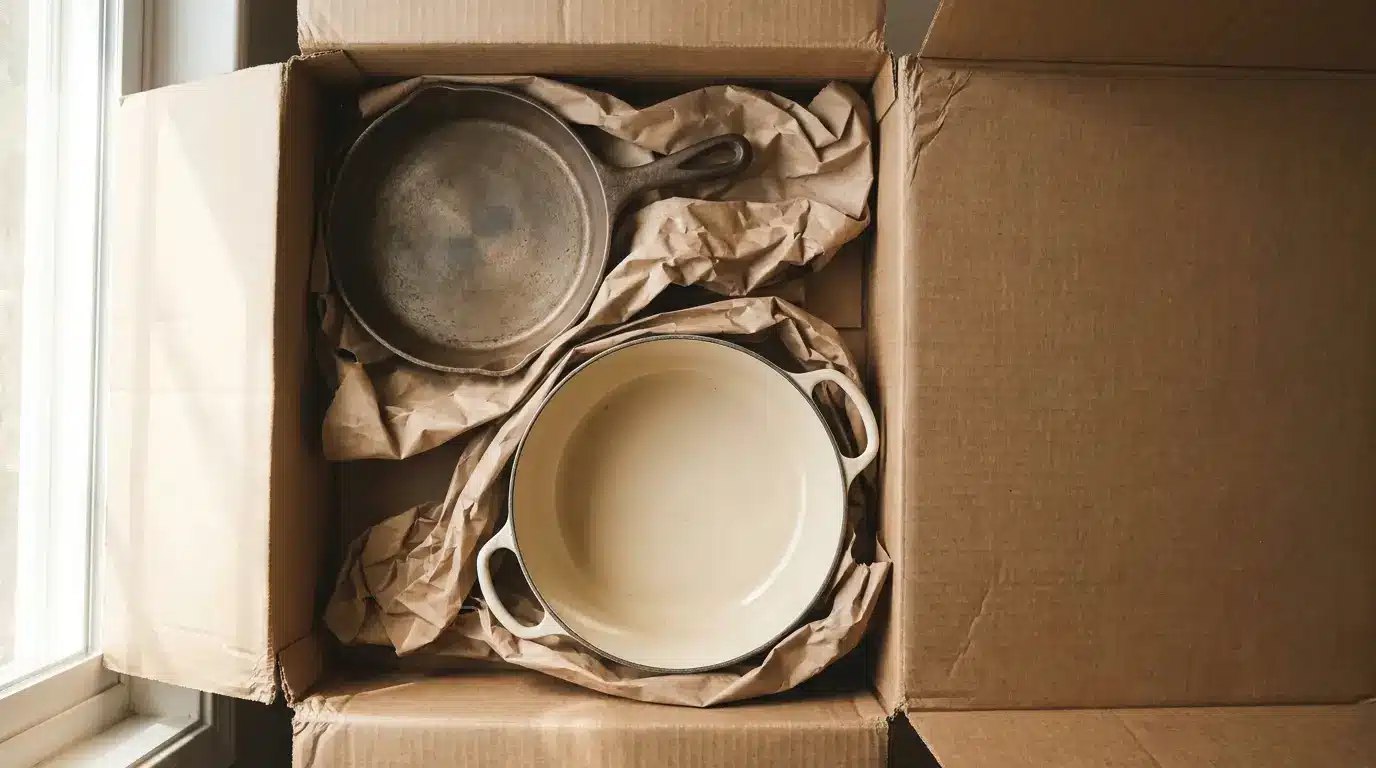
The method is not complicated, and the details matter.
Use dish packs, which are the double-walled boxes made for kitchen items, and keep them small. A box of cast iron hits fifty pounds fast, and an overweight box is a box that gets dropped.
Wrap every piece individually in unprinted packing paper. Newsprint ink transfers onto enamel and light-colored surfaces and is a nuisance to remove. Pieces that will nest need paper or felt between every layer, no exceptions, and they should be wrapped as a unit afterward so they cannot shift.
Lids come off and get wrapped separately. Glass lids deserve bubble wrap and a spot where nothing heavy sits on them, ideally standing on edge rather than lying flat.
For bare cast iron and carbon steel, wipe on a very light coat of oil, then wrap in paper. Skip the plastic bag, which traps moisture against the metal and creates the exact problem it was meant to prevent. A few silica gel packets tossed into the box help, especially for a move through a humid stretch of the country.
Fill every void. A box that rattles when it’s tilted has not been packed; it has been loaded.
Some Things Ride in the Car
A small number of pieces are worth keeping out of the truck entirely.
Anything irreplaceable, sentimental, or absurdly expensive belongs in a car trunk with the passports and the laptops. Knives are on this list too, wrapped in blade guards, since loose blades in a moving box are a hazard to both the blade and whoever opens the box.
On the other end, unpack the kitchen early rather than last. Cast iron with any hint of surface rust wants attention promptly, and a light scrub with oil and a hot oven usually restores it completely. Inspect everything while it’s coming out of boxes, because interstate claims run on a deadline, generally nine months from delivery, and a chip discovered a year later is simply a chip.