

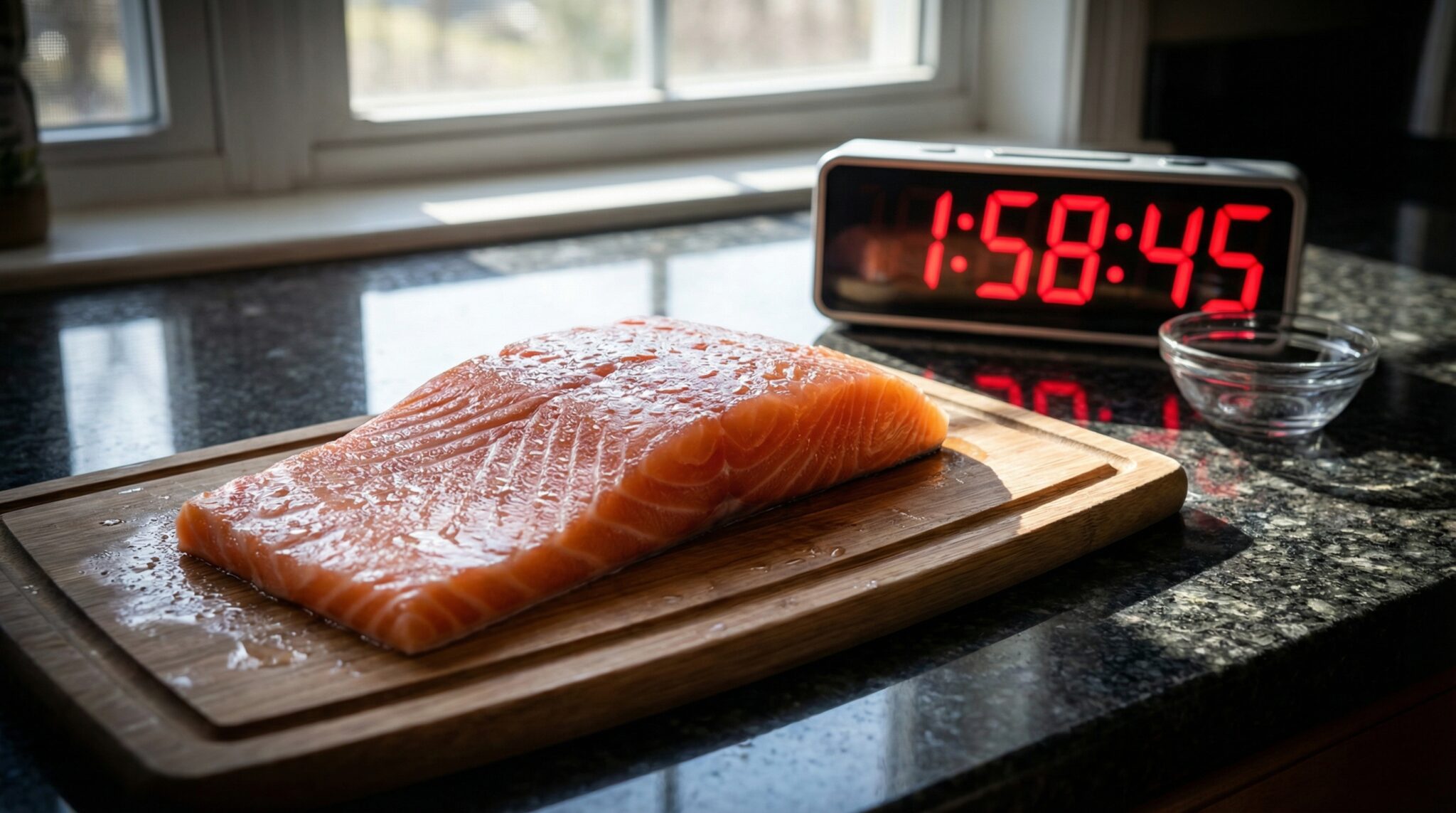
Left Raw Fish Out? Here’s Your (Annoyingly Short) Safety Window
If you’ve ever walked into your kitchen, spotted a package of salmon lounging on the counter like it pays rent, and felt your soul leave your body… hi. Same.
Raw fish is not like that block of cheddar you “accidentally” left out during movie night. Bacteria on fish can multiply fast at room temp, which is why food safety people get so dramatic about it. And honestly? They’re not wrong.
Here’s the rule you actually need:
- Up to 2 hours at room temp (about 68-90°F)
- Up to 1 hour if it’s hot out (above 90°F)
After that, it’s not a “maybe.” It’s a nope.
And yes, I know it looks fine. Fish loves to look innocent right before it ruins your weekend.
The part everyone misses: your timer started at the store
This is the sneaky bit. The countdown doesn’t start when you stroll into your house like a triumphant grocery warrior.
It starts when the fish stops being properly cold usually right around checkout.
So if you:
- checked out at 5:10,
- got stuck in traffic,
- “just popped into Target for one thing” (lies),
- then chatted in the driveway…
…your fish has been making questionable life choices that whole time.
Use your receipt time as your starting point and do the math from there.
If you can’t reconstruct the timeline confidently? I’m going to be the boring adult for a second: toss it. Uncertain time = zero safe hours.
Quick cheat sheet (because you’re busy and I respect that)
- Counter, normal room temp: 2 hours max → cook it or refrigerate it
- Counter, hot day / warm kitchen: 1 hour max → cook it or refrigerate it
- Fridge (40°F or colder): 1-2 days (I aim for within 24 hours for best quality)
- Freezer (0°F): a few months (lean fish lasts longer; fatty fish gets sad faster)
Why fish goes bad so fast (without the science lecture)
Fish is basically a perfect little bacteria spa: moist, protein rich, and usually handled a bunch before you even meet it. And the “danger zone” for rapid bacterial growth is 40°F to 140°F aka “most of your kitchen.”
Also: some fish are extra spicy dangerous. I’m looking at you, tuna and mackerel.
If certain fish sit too warm, they can form histamine (scombrotoxin). Here’s the rude part: cooking won’t fix it. Freezing won’t fix it. Marinating won’t fix it. (Ceviche is delicious, but lime juice isn’t a magic force field.)
So if you’re ever trying to talk yourself into eating room temp tuna because “I’ll just cook it really well”… please don’t. Your stomach will not applaud your optimism.
How I store fresh fish so it doesn’t try to kill us
When you get home, treat fish like it’s a ticking clock (because it is).
Here’s what I do:
- Put it in the coldest part of the fridge usually the bottom shelf or the meat drawer.
- Keep it sealed and contained. Tight wrap or an airtight container, and I like to set it on a tray/plate to catch drips (because cross contamination is not the kind of kitchen drama we need).
- Use a fridge thermometer if you’re not sure about your fridge. The dial inside your fridge is basically decorative.
And if it’s summer or you’re running errands: bring an insulated bag + ice packs and buy seafood last. This is one of those boring habits that saves you from playing “food poisoning roulette” later.
If you can’t cook it within 24 hours, freeze it
This is my personal rule because I live in reality where plans change and Tuesdays happen.
If you’re not cooking fish soon:
- Freeze it ASAP
- Press out as much air as possible (freezer burn is a thief of joy)
Frozen fish can last a while, but freezer storage time limits mean quality is best when you don’t leave it in there until it becomes an archaeological artifact.
Thawing fish: do not “just leave it on the counter,” I beg you
If you remember one thing: never thaw fish on the counter. The outside warms up into the danger zone while the inside is still frozen, and bacteria throw a little rave on the surface.
Use one of these instead:
1) Fridge thawing (safest, easiest)
- A typical fillet might thaw in 10-12 hours
- Bigger pieces can take up to 24 hours
- Cook promptly after thawing for best quality
2) Cold water thawing (when dinner is looming)
- Seal fish in a watertight bag
- Submerge in cold water
- Change the water every 20-30 minutes
- A pound usually takes about an hour
- Cook immediately after
Important weird but real warning for vacuum sealed fish
If your fish is in vacuum sealed packaging, open or puncture the package before thawing in the fridge.
Low oxygen environments can allow botulism toxin to form during slow thawing. (I know. Love that for us.) Opening it removes that low oxygen situation.
Why the sniff test isn’t a superhero
I wish smelling food worked like a magical lie detector. It doesn’t.
Fish can look and smell totally fine and still be unsafe if it’s been in the danger zone while sashimi refrigerator storage time runs too long. Time and temperature beat vibes.
That said, if you notice any of these, don’t negotiate with it:
- Sour/ammonia smell (not “ocean-y,” more “chemistry experiment”)
- Slimy or mushy texture
- Whole fish with cloudy/sunken eyes
But again: the clock comes first.
Who really shouldn’t mess around with raw fish
If any of these apply, it’s best to skip raw fish (even from “nice” places) because the risk is higher:
- Pregnant or breastfeeding
- Kids under 5
- Adults over 65
- Anyone immunocompromised
- People with liver disease
For these groups (and honestly, for anyone who wants to play it safe), cook fish to 145°F internal temp.
My bottom line (aka: what I’d tell you in my kitchen)
If raw fish has been out:
- More than 2 hours (or 1 hour if it’s hot): toss it.
- If you’re not sure how long: toss it.
- Store it cold, freeze it if tomorrow looks unrealistic, thaw it safely, and don’t let your nose be the boss of you.
Fish is delicious. Food poisoning is… an experience you don’t need.